 Mirissa Whale Watching Tours
Ethical Whale Watching in Mirissa
Ethical whale watching in Mirissa is possible, but it is not the default. Sri Lanka has real laws about how boats approach whales, a ban on swimming with them, and a documented gap between what the law says and what happens on the water. This page explains the rules, the crowding problem, the penalties and the questions that help you choose a boat that keeps its distance. No whale is ever promised on any trip here, and the honest odds below come from the operators themselves. The boats themselves are compared on Mirissa whale watching tours compared.
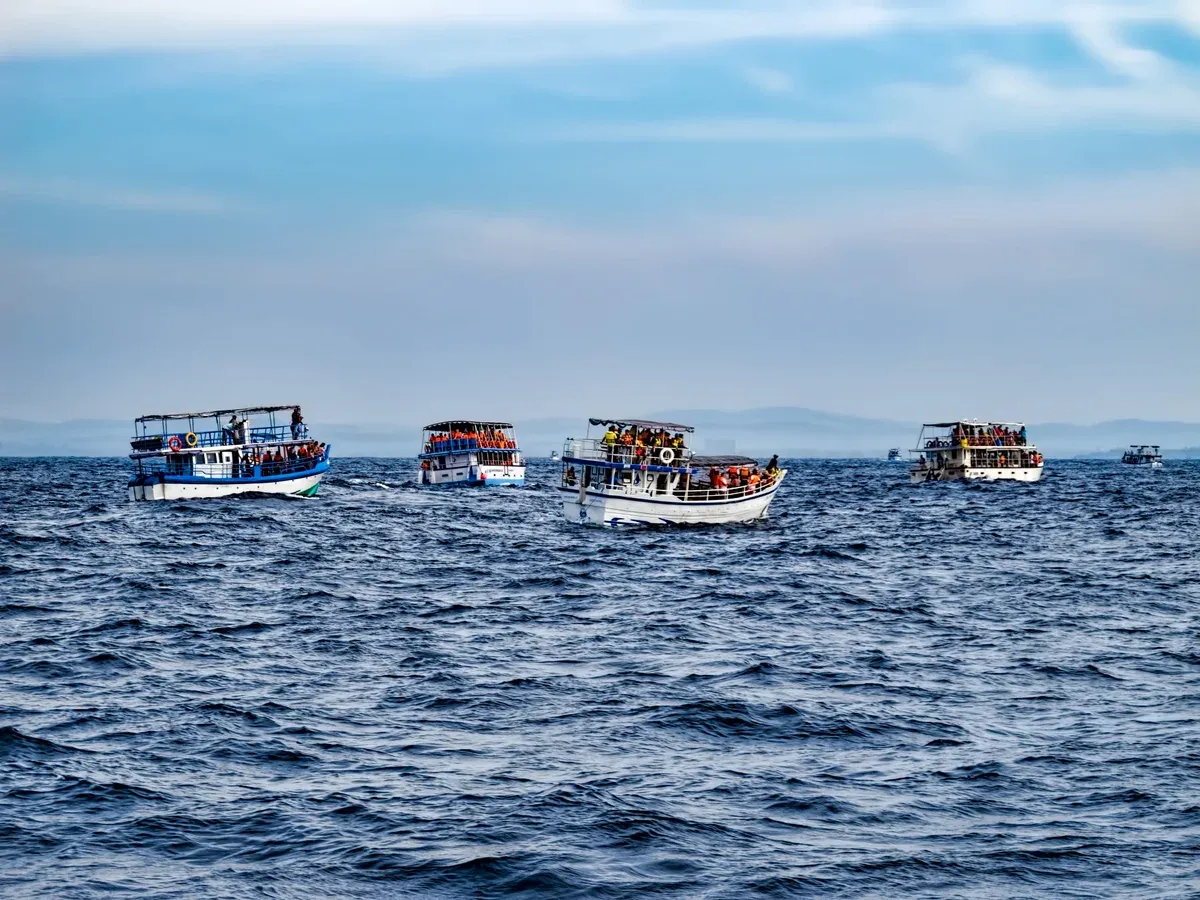
Whale watching boats off the southern tip of Sri Lanka. Photo: Dan Lundberg, CC BY-SA 2.0, via Wikimedia Commons
Quick answer The rules and how to choose a responsible boat
Ethical whale watching in Mirissa is legal whale watching. Sri Lanka's Sea Mammals Regulations of 2012, amended in 2019, set a 100 metre minimum distance from whales and ban swimming with them without written permission from the Department of Wildlife Conservation. The problem is enforcement, not the law.
Key takeaways
- Boats must slow at 400 metres, cut engines at 100 metres and never close in further. See the full rules at sea below.
- Swimming with whales is illegal without DWC written permission. Research by The Pearl Protectors found 73% of Mirissa operators engaged in illegal whale swimming.
- Ask a responsible operator the right questions before you pay. The Whale Watching Club catamaran states its own whale odds at about 50% and takes up to 55 guests on a 60 ft catamaran.
- Captains coordinate by radio and race to sightings, and journalists have counted up to 17 vessels around one whale. Plan for it and read the crowding section.
The Law That Governs Mirissa Whale Watching
Whale watching in Sri Lanka is not a free for all. A specific set of national regulations tells boats exactly how they must behave around whales and dolphins.
Which Law Applies
The governing law is the Sea Mammals (Observation, Regulation and Control) Regulations, No. 1 of 2012, issued under the Fauna and Flora Protection Ordinance and amended in 2019. Every whale watching vessel in the country must hold an annual licence from the Department of Wildlife Conservation, and the DWC Director General must approve the operation in advance. In practice this means a licensed boat in Mirissa is operating under binding rules about distance, speed and engines, not voluntary guidelines.
For you as a traveller, the practical consequence is simple. If a boat breaks these rules, it is not being cheeky. It is breaking national law, and the penalties run from licence revocation to fines and potential imprisonment. Violations can be reported on the public hotline 1992 or by emailing evidence to [email protected].
Enforcement Is the Weak Point
The DWC has acknowledged, in its own words, that it cannot monitor every inch of the ocean. No arrests had been reported in the reporting cited here, despite documented violations. Research by The Pearl Protectors found 73% of operators in Mirissa and 83% in Trincomalee engaging in illegal whale swimming activities. Despite the legal 100 metre minimum, operators are frequently reported approaching whales within 2-3 metres.
There are signs of change. The Fisheries Minister announced stern action after 31 December 2025, sports fishing licence issuance was temporarily halted because some operators misuse such licences to run illegal swim trips, and the Marine Environment Protection Authority plans certifications for whale watching boats that follow sustainable practice. Until such certification exists, the burden of choosing well sits with you, the passenger.
The Rules at Sea, Distance by Distance
The 2012 regulations are precise about how a vessel may approach a whale. Here is what the law requires and what it means on the water.
Distances, Speed and Engines
The numbers below come from reporting on the Sea Mammals Regulations themselves. The pattern is a gradual slowdown, then silence, then a hard floor no boat may cross. The same rules apply a shorter distance for dolphins and other marine mammals, at 50 metres.
Learn these numbers before you board, because they are the yardstick you can judge any crew by. A captain who slows early and cuts the engine well out from a whale is doing what the law and good practice demand.
| Situation | What the law requires |
|---|---|
| Approaching a whale | Reduce speed gradually from 400 metres out |
| Within 100 metres of a whale | Engine must be switched off |
| Closest legal distance to a whale | Never closer than 100 metres |
| Other marine mammals, such as dolphins | Never closer than 50 metres |
| Swimming, snorkelling or diving with whales | Prohibited without written DWC permission |
| Operating a whale watching vessel | Annual DWC licence and Director General approval required |
What a Careful Crew Looks Like
One Mirissa operator, whale-watching-mirissa.com, states its own code of conduct on its website. It says it keeps a safe photo distance, never crosses a whale's course, reduces speed to minimise noise on approach, stops the engine when whales or dolphins come close, and does not do swimming, snorkelling or diving with the whales. Another long standing operator, Raja & the Whales, states it has run trips since 2009, more than 17 years, and adheres to international whale watching regulations while sharing research data with marine conservation organisations. These are operator claims, not independent audits, but they show what a boat can commit to in writing.
The distance rule also protects your own sighting. A whale approached slowly and left in peace stays at the surface longer. A whale chased, or boxed in by racing boats, dives. Patience is both the ethical choice and the better one for actually seeing the animal.
Sources: The Morning, The Morning
The Dark Side of Whale Watching in Sri Lanka
Boat crowding around whales off Mirissa, filmed from a tour boat. Third-party video by Roman_onboard. We did not shoot it and have no relationship with the creator.
Can You Swim With Whales in Sri Lanka?
No. Swimming with whales in Sri Lanka is illegal without written permission, and that permission is rarely granted.
The Legal Answer
Passengers are prohibited from entering the water to swim with whales without explicit permission from the Director General of the Department of Wildlife Conservation. That permission is reported to be granted only for scientific documentation. So if a tour in Mirissa offers to put you in the water with a blue whale, it is offering to break the law, and you would be the one in the water when it does.
No tour sold on this site includes swimming with whales.
How Common Is the Violation
Common enough that it has a name in the local press. Research by The Pearl Protectors found 73% of operators in Mirissa and 83% of operators in Trincomalee engaging in illegal whale swimming activities. Some operators misuse sports fishing licences to run swim trips, which is why licence issuance was temporarily halted and the Fisheries Minister promised stern action after 31 December 2025. The consequences are not just legal. Illegal swimming causes behavioural disruption, increased stress, mother and calf separation, and acoustic disruption from motorboats, according to reporting on the issue.
If you want to swim on your Mirissa morning, book a trip where the swim stop is with turtles, not whales. The blue whale and turtle snorkeling combo pairs the whale cruise with 1.5 hours snorkeling with sea turtles near the shore, which is a legal and lower impact combination.
Sources: The Morning
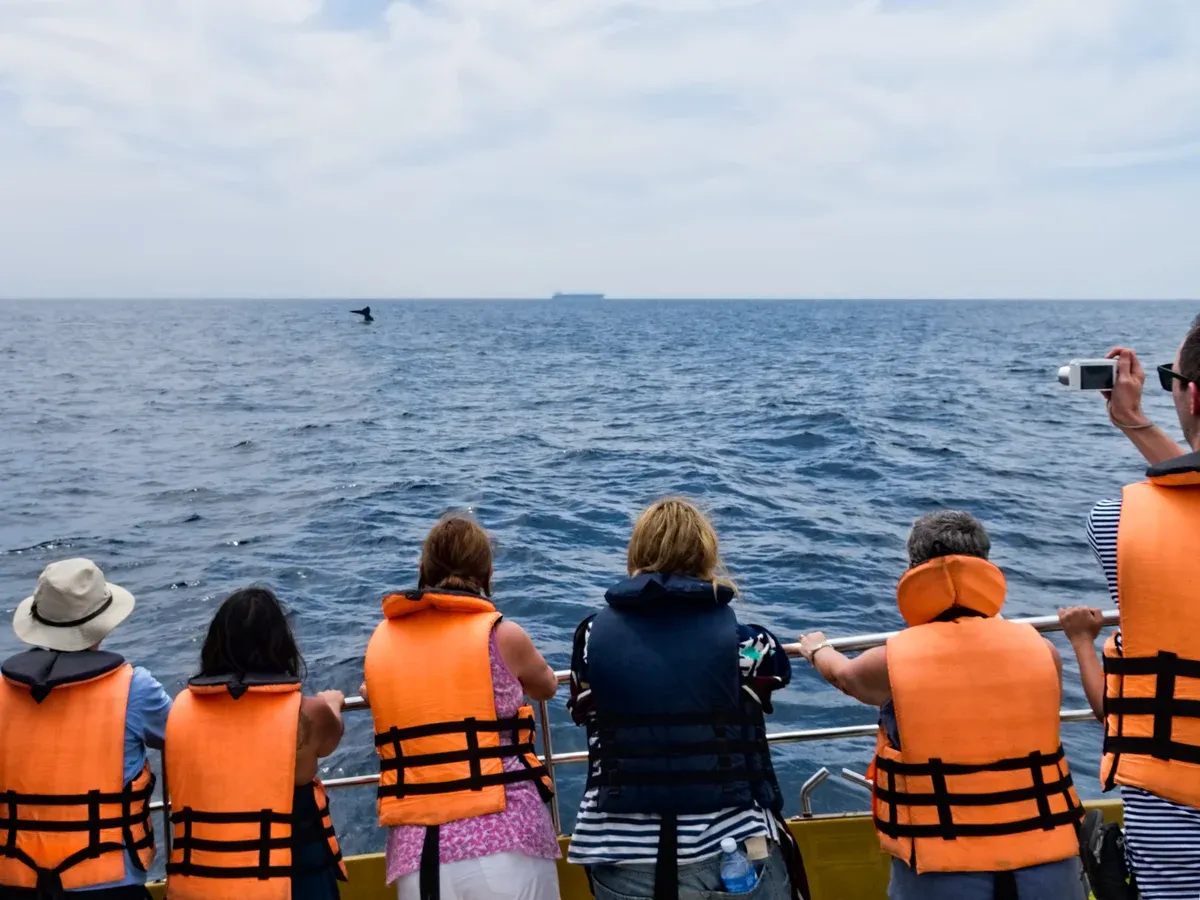
Passengers watch a blue whale dive far off the bow. Photo: Dan Lundberg, CC BY-SA 2.0, via Wikimedia Commons
Crowding, Radio Racing and Ship Strikes
The two biggest ethical problems in Mirissa are not written in any law. They are how many boats arrive at one whale, and what happens when whales are pushed toward the shipping lanes.
Boat Crowding and Radio Racing
Captains communicate sighting locations by radio and race to arrive first, which leads to crowding, view blocking, chasing and boats approaching too quickly. A visiting journalist writing for Atlas & Boots counted 17 vessels chasing one whale on a peak season morning, on a two storey vessel carrying about 80 passengers, out of roughly 20 vessels that departed that day. The same account goes as far as recommending travellers skip Mirissa and try Trincomalee on the east coast or nearby Koggala instead.
This matters because the blue whales off Sri Lanka are a resident, non-migratory population. They are not passing through on migration. Crowding pressure here is chronic, and sightings have declined in ways attributed to human caused stress. Chasing can push whales out of their preferred feeding grounds.
The Shipping Lane Next Door
One of the busiest international shipping lanes in the world passes near the whales' feeding grounds off southern Sri Lanka. Heavy shipping lanes intersect whale habitats, and strike fatalities are often unreported because whales sink after they are hit. When tour boats crowd and chase a whale, they can push it out of safe water and toward that traffic.
This is the sharpest ethical argument for choosing a boat that keeps its distance and does not join the race. Fewer boats harrying an animal means a lower chance it ends up in the lane.
Sources: Atlas & Boots, The Wildlife Diaries, The Morning
How to Pick a Responsible Boat in Mirissa
You cannot audit a boat from the beach, but you can ask the right questions before paying and know what to watch for once at sea.
Questions to Ask Before You Book
Ask these four questions and listen carefully to the answers. First, does the boat hold a DWC licence? All legal vessels must hold an annual one. Second, will the crew swim with or put passengers in the water with whales? If yes, walk away, because that is illegal without DWC written permission. Third, how close does the boat go? The honest answer is that the law says engines off at 100 metres and no closer than 100 metres from a whale. Fourth, what are the actual odds of seeing a whale? A crew that quotes a modest, honest number is showing you how it treats every other claim it makes.
How a crew talks about odds is a strong signal. Geeth's crew states about 30% for whales and 80% for dolphins. The Whale Watching Club states whales about 50% and dolphins about 90%, with no guarantee. One large cruiser operation claims 99.9%, with a free re-sail or a $17 adult refund if no whales show. These figures are operator claims, not independent studies, and no official sighting statistic exists in Sri Lanka.
What to Watch for on the Water
Once underway, the law gives you concrete things to check. Watch whether the boat slows down gradually from a good distance out. Watch whether the engine goes quiet before you are anywhere near a whale. If the boat holds off, you should feel like the whale is being watched, not chased. If the crew joins a pack of boats boxing an animal in, or puts swimmers in the water, you are watching a violation.
Boat size matters too. A first hand account describes a two storey vessel with about 80 passengers, and boats racing a whale in groups of up to 17 vessels. Smaller shared boats with clear guest caps give a crew more room to do the right thing. The Queen Whale catamaran caps at 55 guests on a 60 ft boat, and the private speed boat carries just your group on 12 seats.
What Operators on This Site State About Their Practice
The table below lists what listings on this site state about price, group size and whether the harbour entry ticket is included, since a harbour ticket that is extra changes the real cost of a trip. The $28 breakfast trip and the $32 Geeth's crew trip both leave the entry ticket as an add-on or optional, while the $50 Eagle Eye trimaran states all fees and taxes are in the price and the $90 all inclusive trip names the animal welfare ticket among its inclusions. Prices are the operators' listed prices.
| Trip | Listed price | Harbour ticket | Group size | Operator's stated whale odds |
|---|---|---|---|---|
| Queen Whale Catamaran | $55 | Listing does not say | Up to 55 guests | About 50% |
| Geeth's Crew Cruise | $32 | Extra, add at checkout or pay at harbour | Shared | About 30% |
| Whale Watching with Breakfast | $28 | Optional add-on | Shared | 30-40% |
| Eagle Eye Trimaran | $50 | Included, all fees and taxes | Up to 70 travelers | None stated |
| All Inclusive Boat Ride | $90 | Included | Shared | None stated |
| Private Speed Boat | $550 | Extra, about $19-20 per person at check-in | Private, 12 seats | None stated |
Speak Up, and Report What You See
Passengers have more influence than they think. If your boat approaches too close, a calm word to the crew often works, because crews care about reviews. If a boat puts swimmers in the water with a whale, that is a crime you can report. Sri Lanka runs a public hotline, 1992, and the Department of Wildlife Conservation accepts evidence by email at [email protected]. Take photos or video if you can do so safely. Reporting is one of the few enforcement levers that currently exists, given the DWC's own admission that it cannot monitor every inch of the ocean.
Penalties for violations include licence revocation, fines and potential imprisonment. Every report with evidence builds the paper trail that makes those penalties usable. It also rewards the operators who do follow the rules, by making the alternative riskier than compliance.
Sources: The Morning, operator listings on this site
Do and Do Not at Sea
A short checklist for a low impact morning on the water off Mirissa.
Do
- Do book a licensed boat with a crew that states its whale odds honestly, because honesty about a 30-50% chance tells you how the crew treats everything else.
- Do learn the 400 metre slowdown and the 100 metre engine off rule before you board, so you can recognise good practice when you see it.
- Do keep your distance expectations realistic and accept that a whale left alone is a whale that stays visible longer.
- Do report swim-with-whales activity on the 1992 hotline or by email to [email protected], because public reports are currently the main enforcement lever.
- Do consider the east coast alternative if crowding bothers you, since Trincomalee's season runs roughly March to September or October, mirroring Mirissa's November to April window.
Don't
- Don't book any trip that offers to put you in the water with a whale, because swimming with whales is illegal in Sri Lanka without written DWC permission and research found 73% of Mirissa operators engaged in it.
- Don't chase a better photo by encouraging a crew to push closer, because operators are frequently reported approaching within 2-3 metres despite the 100 metre law.
- Don't reward racing crews, since captains who coordinate by radio and race to sightings create the crowding that pushes whales toward the shipping lanes.
- Don't assume the listed price is the full price, because several trips add the harbour entry ticket at checkout or the harbour, about $19-20 per person on the private boat.
Questions About Ethical Whale Watching in Mirissa
Is whale watching in Mirissa ethical?
It depends entirely on the boat. The law is strict, with a 100 metre minimum distance and engines off within that range, but The Pearl Protectors found 73% of Mirissa operators engaged in illegal whale swimming, and reporters have counted 17 vessels around a single whale. Choosing a crew that states its rules and its odds, such as the Whale Watching Club catamaran which states about 50% whale odds with no guarantee, is what makes the trip defensible.
What are the Mirissa whale watching rules?
The Sea Mammals Regulations No. 1 of 2012, amended 2019, require boats to slow from 400 metres, cut engines at 100 metres and never approach a whale closer than 100 metres, with a 50 metre limit for dolphins and other marine mammals. All vessels need an annual DWC licence. The full breakdown is in our rules at sea section.
How close can a boat legally get to a whale?
No closer than 100 metres, with the engine switched off from 100 metres out, under the national regulations. Despite this, operators are frequently reported approaching within 2-3 metres. If your boat closes in, a calm word to the crew is worth trying, and the picking a responsible boat section lists what to watch for.
What happens if a whale watching boat breaks the rules in Sri Lanka?
Penalties include licence revocation, fines and potential imprisonment. In practice, enforcement is thin, because the DWC acknowledges it cannot monitor every inch of the ocean and no arrests had been reported in the coverage we cite. You can report violations with evidence via the 1992 hotline or [email protected]. More detail is in our law section.
Why do Mirissa boats crowd around whales?
Captains share sighting locations by radio and race to arrive first, which produces crowding, view blocking and fast approaches. One journalist counted 17 vessels chasing one whale in peak season, from roughly 20 vessels out that morning. Boats with a published guest cap, like the 55 guest Queen Whale catamaran, at least tell you how full the deck will be.
Do whale strikes by ships happen off southern Sri Lanka?
Yes. One of the world's busiest shipping lanes passes near the whales' feeding grounds, and strike fatalities are often unreported because whales sink after being hit. Crowding and chasing by tour boats can push whales out of feeding grounds and toward that lane, which is a core reason to choose a boat that keeps its distance. Compare trips and their stated practices on Mirissa Whale Watching Tours.